In our last post, we looked at why Right to Work responsibilities are expanding from 1 October 2026. Here's the practical follow-up: what commonly sits in a locum's compliance file, and a closer look at the one check that's changing.
Five areas come up again and again:
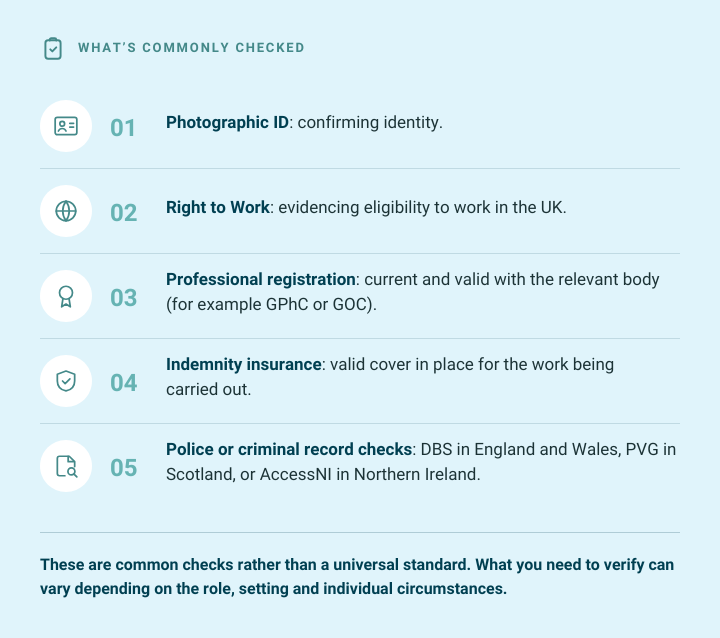
These are common checks rather than a universal standard. What you need to verify can vary depending on the role, setting and individual circumstances, so they're worth considering alongside your own compliance policy.
Right to Work deserves a closer look because it isn't one fixed check. The appropriate method depends on the individual's status and circumstances, here are a few examples:
Manual document check: using original documents from List A or List B. The employer must obtain and physically possess the original documents when checking their validity. The check can take place with the individual present in person or via live video link, but viewing documents held up on a video call, or relying on scanned copies, is not sufficient.
Home Office online check: using the Home Office online service and a share code where an individual's immigration status can be checked digitally. For people with an eVisa, the online service is used to evidence their Right to Work.
Digital verification: using a certified Right to Work Digital Verification Service Provider for eligible British and Irish passport holders.
Employer Checking Service (ECS): used in circumstances where someone's status cannot be verified through the usual document or online routes, including certain outstanding applications, reviews or appeals.
That distinction becomes more significant from 1 October 2026, when Right to Work responsibilities expand to additional working arrangements under Section 48 of the Border Security, Asylum and Immigration Act 2025. The detailed statutory Code of Practice is still being finalised, organisations should check the final versions ahead of October 1st.
Knowing what to check is one thing. Keeping those checks current and consistent across different roles and working arrangements is another, and that's the question we’ll deal with next time.